
 Concrete Calculator | Solve Your Estimation Problems And Work out the amount of concrete you need.
What is the Correct Mix for Floor Screed? (Floor Screed Ratio)
Call for today’s best price on: 0808 196 7812
Concrete flooring is rapidly increasing in popularity, and it’s easy to see why. Not only does the use of concrete make this flooring type highly durable and affordable, but using floor screed achieves a sleek, stylish and completely flawless finish.
Floor screed plays a critical role in concrete flooring, particularly for domestic properties and businesses. In fact, this final layer does its job so well that it is often used in replacement of carpets or wooden flooring topping the concrete.
So, to help you understand the benefits of floor screed and how best to use the material, our experts have shared this comprehensive floor screed mix guide.

Jump to section:
- What is floor screed?
- What is the ratio needed for floor screed?
- What are the different types of floor screed?
- What are the applications for floor screed?
- Preparation before laying floor screed
- Curing and drying times
- Common mistakes to avoid
What is floor screed?
Screed is a mixture of cement and sharp sand, which is set in a thin layer.
For concrete flooring, it is designed to sit on top of a concrete subfloor. Then, it can either be topped with an additional type of decorative flooring (such as wooden panels or carpet) or left as it is.
The unique qualities of floor screed are all a result of its use of finer aggregates. Unlike concrete (which uses larger aggregates to give it high strength) floor screed achieves a much smoother and neater finish when set. It is also much easier to ensure floor screed sets in a completely even layer.
As a result, when combined with a layer of concrete underneath, you get the best of both worlds for your flooring.
What is the ratio needed for floor screed?
As mentioned above, floor screed is usually made by mixing cement, aggregates and water.
The standard screed ratio is usually 5:1 sand/cement.
However, the screed ratio required will depend on the project at hand, and where the flooring will be located.
For example, a domestic property will require floor screed that is much weaker and finer than that of an industrial warehouse, where strength (even though it doesn’t need to be as strong as regular concrete) will still be a high priority.
So, although the screed ratio will vary between projects here is a general guideline for standard floor screed mixes:
- For a standard screed mix – 5:1 sand/cement ratio
- For a stronger screed mix – 4:1 sand/cement ratio
- For a faster-drying screed mix – 3:1 sand/cement ratio
Other factors to take into consideration when determining your screed ratio include the thickness of the screed layer, and the type of screed that you are using.
If you have any questions about screed ratios, then consult a specialist concrete supplier, like the team here at iMix Concrete.
What are the different types of screed and their uses?
There are a variety of screed types available, which are designed for use for different purposes, including:
- Bonded screed – this is set on top of an existing layer of concrete or asphalt surface. It is then bonded to the layer below by using a bonding agent.
- Unbonded screed – this is set on top of a damp-proof membrane. But, it is not bonded to the underlying surface.
- Floating screed – this is set on top of an insulating layer, such as polystyrene foam. It is also not bonded to the underlying surface.
- Insulating screed – this is mixed with insulating materials (such as perlite or vermiculite) to help insulate the flooring.
- Structural screed – this type is designed to be set in a thicker layer, providing a structural base.
- Topping screed – this type is designed to be set in a thinner layer, to level and smooth an existing floor.
At iMix Concrete, we can expertly mix screed of any type, to meet the specific requirements of any project.
We even offer our own range of iFlow Liquid Screed, and are trusted suppliers of Cemfloor Level Plus liquid screed.
What are the applications of floor screed?
Screed is an incredibly versatile high performance material.
Generally speaking, screed is designed to be poured on top of a raw concrete subfloor as an efficient additional step, which achieves a much higher quality finish. Essentially, it bridges the gap between the raw concrete subfloor and the aesthetics of the final end result.
Common applications for floor screed include:
- Levelling uneven flooring surfaces – Liquid screed efficiently smooths out structural concrete slabs, achieving a much neater and flawless finish
- Preparing flooring for other materials – In many cases, the concrete used for the subfloor would be too uneven for other flooring materials to be laid on top (e.g. wood or tiles). But with floor screed, the surface can be prepared for the addition of the final surface material. What’s more, the screed also helps to protect these coverings from any moisture rising through the subfloor.
- Creating a concrete floor – Alternatively, if a concrete floor is being prepared, floor screed ensures the concrete has a neat, pristine finish, while still being suitably durable and resistant to traffic.
- Underfloor heating – As screed is an excellent thermal conductor, it is often set over heating pipes to ensure heat is evenly distributed across the room.
Our specialist team have extensive experience working with screed, and are the trusted screed suppliers of businesses, property owners and construction companies across London and the surrounding regions.
Preparation before laying screed
When laying screed, the quality of the end result depends on how well you prepare the site.
To prepare the subfloor, we recommend taking the following steps:
- Clean the subfloor – Ensuring all dust, grease or debris is removed. This is because, if any contaminants are present, this can prevent the screed from bonding correctly.
- For bonded screed, apply a bonding agent – By using a primer (e.g. SBR or PVA) you can ensure the new screed layer successfully adheres to the existing concrete.
- For unbonded screed, add a damp-proofing membrane – Adding a polythene membrane will ensure that the flooring is dependably damp-proof.
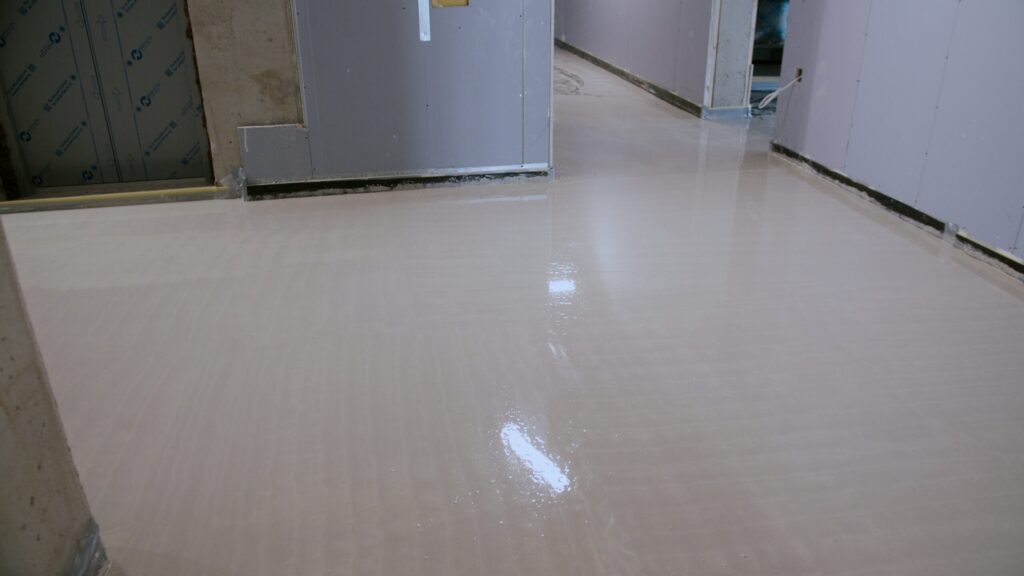
- Add edging foam around the perimeter – These strips allow the screed to expand and contract (as is natural) without risking cracking in the walls.
Curing and drying times
When applying floor screed, patience is imperative. To achieve the best result, you’ll need to ensure you’re following the recommended curing and drying times.
We recommend following the following general times:
- Drying time – Generally, the rule for estimating drying times for traditional screed is allowing one day per 1mm of thickness. So for example, a 10mm floor screed would require you to wait 10 days before adding the final finishes.
- Foot traffic – Usually, floor screed can allow foot traffic after 24-48 hours after it has been poured. However, this will vary depending on the mixture used and the surrounding environment.
- Full strength – In most cases, the screed will reach its full strength 28 days after it has been poured.
If you are unsure about drying times, always ask your suppliers – they will have the information on hand as to how long your specific mixture will take to cure and dry, based on your requirements.
Common mistakes to avoid
When pouring screed, common mistakes to be aware of – and to make sure you avoid! – include:
- Using incorrect water ratios – Although adding extra water will make the mixture easier to spread, too much water can result in massive shrinkage and cracking. However on the flipside, not adding enough water makes the mixture crumbly and weak.
- Not considering weather conditions – Attempting to pour screed in bad weather conditions can compromise the end result. For example, high temperatures when pouring can cause the screed to dry too quickly, resulting in curling or cracking.
- Adding the flooring too quickly – Not waiting for the full required drying time can lead to moisture being trapped in between the screed and the flooring finish. This can lead to debonding, or even mould growth. For this reason, we also recommend testing the moisture of the flooring, before fitting the final flooring.
- Insufficient compacting – Failing to correctly tamp down the screed can mean air pockets are left in the screed as it sets. This results in the floor being significantly weaker.
To find out more, or to arrange screed delivery for your upcoming project, don’t hesitate to get in touch.
Need Screed for your Project?
Call for today’s best price:
0808 196 7812
- 800m3+ Daily Concrete Capacity
- Same / Next Day Delivery (by 2pm)
- 2-hour Delivery Windows
- Only Pay For What You Use
- Collections Available
- Out of Hours & Night Delivery
 Independent Supplier